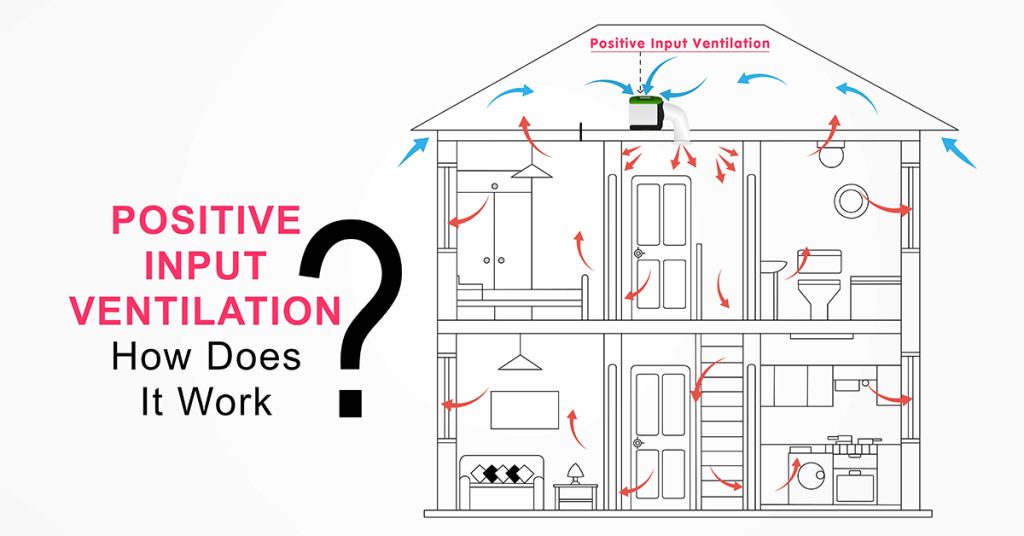
Positive Input Ventilation (PIV)


What causes the problems


Did you know that 58% of people have suffered mould and condensation in their home? If you consider the fact that 90% of the time is spent indoors, it is vitally important to focus on improving indoor air quality (IAQ). It can damage not just the property, but health as well.

Cooking, cleaning and bathing 


These activities generate up to 10 litres of moisture per day. In addition, every load of washing that is hung to dry inside adds 2.5 litres. All together there could be 12.5 litres of moisture generated in the home every single day which can cause condensation and mould.

Volatile organic compounds

Substances like formaldehyde get into the home from things like paint, new furniture and cleaning products. The average person breathes 9,000 litres of indoor air each day, so poor indoor air quality (IAQ) can cause serious risk to health such as heart and respiratory diseases, and asthma being a key concern.

Increased insulation

In the drive to insulate our homes we have created an airtight box where, not just heat, but moisture and chemicals can’t escape. This causes poor indoor air quality, which can contain a cocktail of over 900 chemicals, particles and biological materials, which can have a negative effect on health.


What is Positive Input Ventilation (PIV)?

Positive Input Ventilation (PIV) is an energy-efficient method of ventilating the home. It pushes out and replaces stale unhealthy air with drier fresh air by gently introducing filtered air into the home and increasing the circulation around the property and improving the indoor air quality (IAQ). 

Ventilation removes the root cause of condensation and mould within the home. If a property has high levels of moisture, if left untreated this will allow mould to form causing further issues. By removing the moisture and other pollutants from the air, condensation cannot settle, and mould cannot grow which removes the problem at the source.

The Solution

Positive input ventilation (PIV) is one of the best solutions to tackle poor indoor air quality (IAQ). It is a solution for all types of properties, PIV units are usually situated in a loft or on a wall. Our PIV range offers both solutions whether you live in a house or a flat.

 
PIV Supply and install cost from £899 


What does a thermal inspection cover?

Thermal imaging of the room or problem area cost from £120 

We conduct thermal surveys of your property to identify possible causes.

This means you can rectify issues and save money on your heating bills. 

 Possible reasons that our thermal inspection might identify:

  • Poorly sealed windows and doors
  • Missed, Damaged or inadequate loft insulation
  • Destructive water damage 
  • Cavity wall insulation voids and many more
  • Radiator or Electrical issues.


Whether it be for leaks, paths of air leakage, insulation checks or under floor heating inspections for either commercial or domestic projects, Safeway Construction have a survey to fit your requirements. Our integrity is guaranteed to bring you true results. 

 Condensation problems 

Condensation problems & Black mould inspections from £120

We will advise you on the correct course of action to take on these issues that effect damp. Using a variety of different tools and advanced knowledge of damp and mould issues, he will find you the cause of your damp and mould problem. Most findings are solvable by following instructions to prevent the problem so no cost for unnecessary repairs. 


We have helped hundreds of property owners save thousands of pounds on unnecessary building work by finding the true cause of their damp problem. Contact us for a Damp Survey today and see how we can help you.


All properties have codnnsation, but most properties have sufficient ventilation to dry out condensation before it causes a problem.

Condensation results from excess vapour condensing of a cold surface, at or below the dew point.

Humidity

There are three parts to the equation;

  1. humidity,
  2. temperature and
  3. ventilation,

Each one can cause and problem or resolve it.

Common problem

Vapour condensing into water on cold surfaces is the most common form of dampness in the home. It is most prevalent on the lower surfaces of external ground floor walls. Warm moist air from a kitchen, bathroom, washing machine or drying clothes will condense rapidly when meeting a cold external wall, window or pipe. Add to this humid breath from human and pets.

Cold spots

A wall will be relatively cold at the point where both skins of a cavity wall meet. This is most pronounced at the base of a ground floor wall, which is often more than 5°C cooler than the ambient temperature. The temperature differential can be much greater at night.

Most vulnerable areas

  1. cold water mains pipes,
  2. around edge of top floor rooms (by poorly insulated eaves),
  3. cold and poorly ventilated roof and sub-floor voids,
  4. cold spots such as north facing or shaded walls,
  5. near any embedded metal object (such as old gas lighting piping).
  6. external metal downpipes and supporting brackets,
  7. on and below windows,
  8. by openings, especially the cold section of wall by a door or window
  9. anywhere near a poorly ventilated bathroom, kitchen or laundry room,
  10. by double glazing, often with cold metal frames or without ventilation (many occupier don’t know how to open ajar on the safety lock).

Dew point

The dew point is the temperature that water starts to condense. Humid air from a warm moist kitchen readily condenses on the cooler surfaces of external walls. Typically, a surface only has to be 5°C lower than the ambient temperature for condensation to start to form.

Insulation

Glass and metal are good conductors of heat and therefore lose thermal energy much more rapidly than timber, brick or plaster. Condensation runs down cold windows and frames onto walls beneath them. Metal objects embedded in walls such as behind an electrical socket, cable or pipe can initiate condensation. Cold metal can cause condensation, even in summer.

Ventilation

Although condensation is inevitable, it can be manged with ventilation out at source, combined with sufficient heat, air circulation and regular wiping of wet surfaces.

Drying clothes

Ideally clothes should be dried outside, or with an externally vented clothes drier. Double glazed windows should have trickled vents kept open.

An alternative is to designate wet areas, then manage humidity in those wet areas, by wiping off surface moisture and opening windows often. Victorians used to tile their entrance halls, at the point where cold air meets warm humid air. Bathroom paints and tiles evaporate moisture readily and are easy to wipe down. Top tip; use an electrically heated bathroom mirror.

Passive ventilation

A common mistake is to increase ventilation into a building. This is often counterproductive as the outside air is likely to be cooler than the warm moist internal air, and will cause, rather than alleviate condensation. Positive flow ventilation systems do not necessarily reduce condensation.

Interstitial condensation

In the worst cases, condensation can form within a wall. This is known as interstitial condensation. If the temperature is too warm to condense water vapour and the air outside it more than cold enough to condense vapour, then within the wall or building there exist a dew line. Vapour absorbed naturally by the building material will condense within the building material. This is called insterstilitial condensation. It is rarely visible and rarely causes a problem.

Cold metal embedded objects

Interstitial condensation is most noticeable when a building is composed of material with varying thermal properties, such as a cold wrought iron downpipes attached to walls or metal joist (RSJ). Water is often seen forming on a cold winter’s night below the steal beam of a roof extension.

Small Roofing Repairs from £90

We have set up this department in light of the current economic climate, to to help reduce our carbon footprint & to save our customers time and money. We ues google street view so we can see the type of tile or Slate you have on your roof before we set off you can help by sending a photo if possible. 

Economic Roof Repairs 

We are happy to carry out small roof repairs including; ridge repairs, loose, slipped and missing roof tiles and slates, broken slates, leak repairs, lead flashing and cement work repairs and replacement, plant damage, ivy, moss and tree damage, rotten timer repairs, felt repair and replacement, leaking and broken guttering repairs, as well as repairs to soffits, fascia boards, eves and chimneys.

By sending details of the necessary repair across to us giving us as much information as possible ie: the repair and access available, we will then be able to provide you with a quote to carry out the necessary repair.

This will save you having to sit in waiting for the roofer to turn up, which can’t always happen on time and will help the environment by reducing the amount of fuel being used.

Please contact us and tell us about your roof damage…

07973 443757 phone, WhatsApp,, messenger, text or email the pictures over with a description attached and i will do my best to price the job with minutes of receiving your information.